
DIY Mistakes
How to Find a Stud Before Mounting a TV
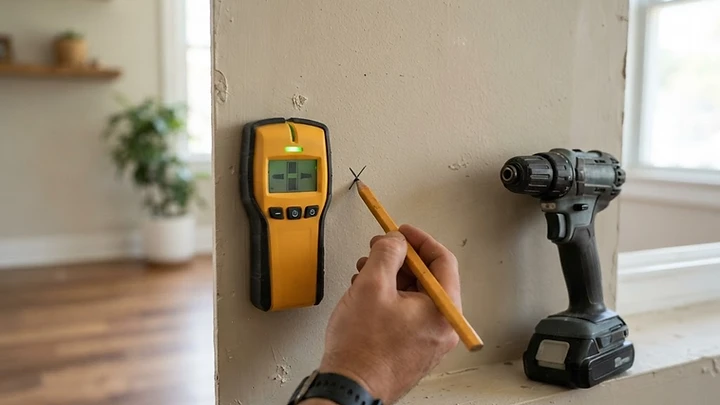
Everything about a TV mount comes down to one question: where are the studs? Every lag bolt either lands centered in solid framing or the whole install is running on borrowed time — that's the difference between a mount that holds for a decade and one that's slowly working loose.
Here's how we locate studs — and how you can do the same on your own wall.
Method #1: The Stud Finder
The obvious one, done right. Electronic finders read density changes behind the drywall; magnetic ones find the screws and nails that fasten the drywall to the framing.
The trick people miss: find the edges, not just "a stud." Slide slowly, mark where it beeps on and where it beeps off, and the center of the stud is between your marks. Then check that the stud actually runs floor-to-ceiling — a single "beep" can be a pipe strap, a patch, or a knot in the drywall. Verify with the next method.
Method #2: The Outlet Trick
Outlets and switches almost always attach to the side of a stud. Pull the cover plate off (power off at the breaker if you're unsure) and you can often see or feel which side the box is nailed to. Measure off the outlet, add 16 inches (or 24 in some homes), and you've got the layout for the whole wall.
Method #3: The Knock Test
Knuckle-rap across the wall at the height you'll mount. Drywall between studs sounds hollow; over a stud it goes tight and solid. This is the oldest method in the book and it works — as a cross-check, not a primary tool. It can't tell you the edges, and it lies on plaster.
Method #4: Measure the Pattern
Framing runs 16 inches on center (sometimes 24). Find one stud, and the next ones sit 16 (or 24) inches along the line. Baseboard trim is often nailed to studs too — look for the nail holes filled at regular intervals.
The Step Everyone Skips: Verify
Before drilling a mount-size hole, prove the stud two ways:
- A tiny pilot hole (1/16-inch bit) where the lag bolt will go. Solid wood offers steady resistance the whole way in; if the bit punches through into nothing, you missed — and a 1/16 hole patches itself
- Check for anything else in the wall. Water pipes and drain lines often run near studs, especially in bathroom and kitchen walls. A finder with AC detection helps, and so does knowing what's on the other side of that wall
When the Studs Don't Cooperate
You found the studs, and they sit three inches off from where the mount's holes need them. That's normal — stud spacing rarely matches mount spacing. The options: shift the mount a touch (usually possible), use a mount with adjustable slots, or add solid backing between studs. What's not an option is putting one bolt in a stud and one in drywall — that's how TVs come off walls.
The Bottom Line
Stud-finding is five minutes of measurement that protects a thousand-dollar screen. Do it slowly, verify twice, drill once. Or skip the detective work — get a quote and we'll bring the stud finder, the level, and the ladder. Read more about our TV mounting in Granbury.
A Couple Studs
A family-run TV mounting and wall hanging business serving Granbury and Weatherford, Texas. One Stud Teaching the Next — every job teaches the next generation the value of doing it right.
Get a QuoteReady to Hang It the Right Way?
A Couple Studs serves Granbury and Weatherford, Texas — get your free quote.
Got a wall? We've got a Stud.
Get your free quote from A Couple Studs — professional TV mounting and wall hanging in Granbury and Weatherford, Texas.